

Imperfect but Still Standing
Story telling from my window ledge

Inspired by (Soul Circle) Summer of Substack Essay Festival.
This week I found myself answering a question posed by Beth Kempton.
Are there any physical objects I’m obsessed about?
No not really, I enjoy beautiful objects but don’t necessarily have to own them. I’m bemused by collectors. What drives them to collect e.g. objets d’art, trinkets, novelties or sets of things? I confess I like to peek into the homes of others, to see what their treasures are, to get a sense of their loves and ways of living.
I sometimes play a game, imagining that my living room is featured in one of those lifestyle magazines where the “person of interest” shares a photo of their living space and tells tiny stories of interesting objects they’ve gathered throughout their life.
I’m pretty sure I could tell a tiny story of everything in my home but today I’m sharing a tiny story of the white lady.
Standing tall, her spine arched backwards, her face lifted towards the sky and arms raised high. Joyous in her pose. I imagine the sun kissing her face as she looks up. She portrays an elegant simplicity, and as a family we lovingly refer to her as ‘the white lady’.
The white lady was a gift I gave my mum many years ago, a Royal Doulton figurine named Awakening. She lived on the mantlepiece of our family home for decades. She wasn’t expensive, but she was admired, treasured, and even served practical purposes now and again. Sometimes she stood as a placeholder for a £10 note awaiting payment to the window cleaner or someone else. “The money is under the white lady,” Dad would say.
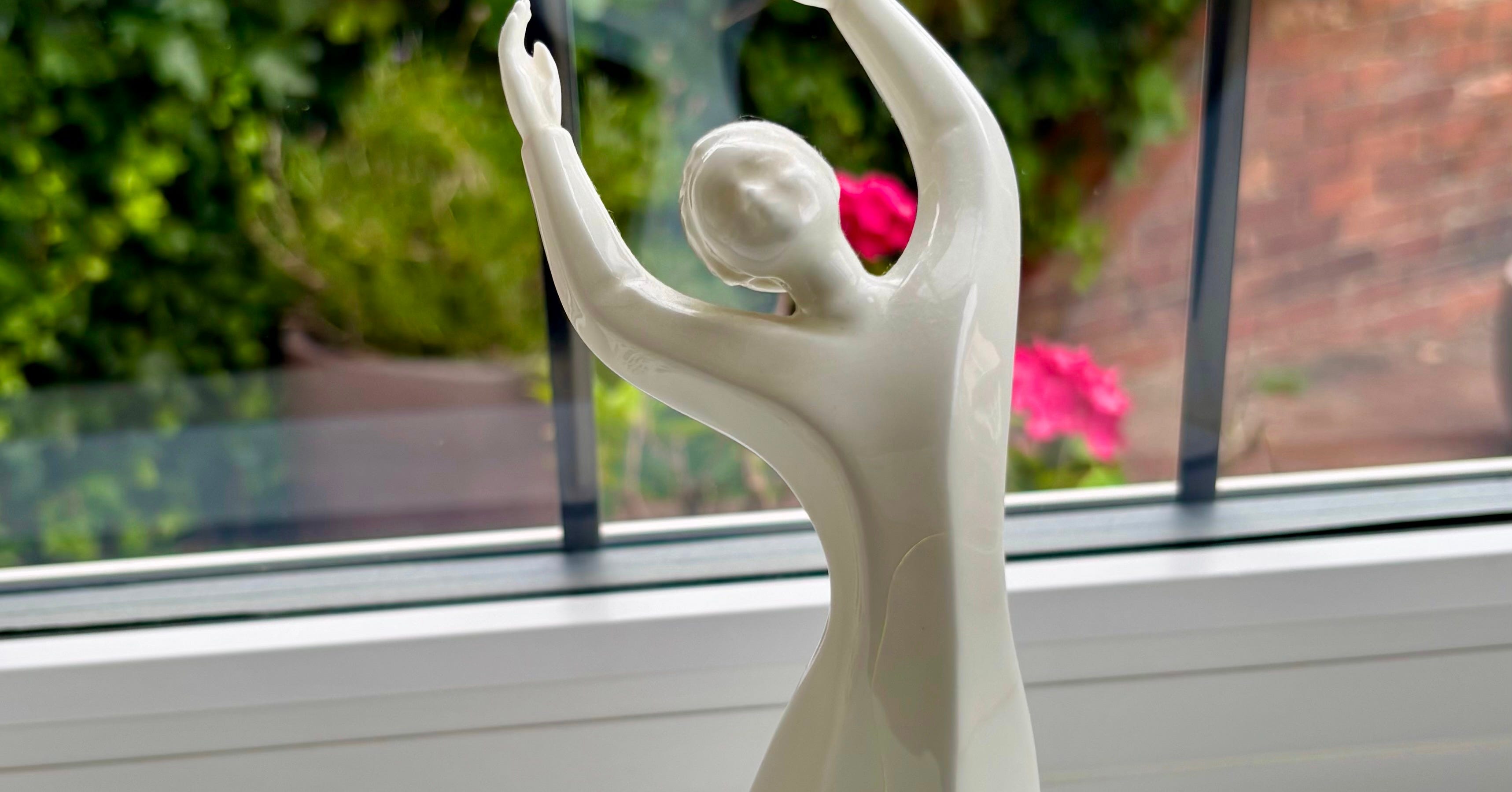
When my siblings and I cleared our parents’ home after they passed, I brought the white lady home with me. She has been on my window ledge ever since, a quiet reminder of my mum.
It’s often surprising which objects hold sentimental value. It’s rarely about the price tag. It’s about the story. We project love, memory and meaning onto certain things, and they become carriers of our personal history.
Some time ago, I was in my front garden when an elderly gentleman stopped to chat. After a few moments he smiled and said, “My wife and I are so pleased to see the white lady is back. She disappeared a few weeks ago and we were so disappointed. We always admire her as we pass.”
Standing at only nine inches tall, I was surprised they could even see her from the street. But I was delighted they shared in her beauty.
“Oh, I moved her when I was redecorating,” I explained, and shared the story of how she came to me.
It struck me then how we create pockets of memory for ourselves, often without realising that others share in them too. Something small, like a figurine on a window ledge, can brighten a stranger’s day.
Recently, when dusting, I noticed a huge crack had appeared on her side. I was devastated. My first impulse was to replace her. I searched and discovered a replacement online. But then I stopped. Why would I want to buy new white lady? It wouldn’t be the one I gifted to my mum. It wouldn’t carry the same history, the same story, the same meaning.
Instead, I thought about living with the crack, maybe even mending her in the way the Japanese do with kintsugi. This technique, which means golden joinery, repairs broken ceramics with lacquer mixed with gold, highlighting the cracks instead of hiding them. It is not just a craft but a philosophy. It honours the flaws and sees them as part of the object’s history, making it even more beautiful and meaningful.
I realised there is no need to erase the cracks in life, they make us who we are. Just as kintsugi celebrates the repaired object as more beautiful for having been broken, we too can learn to honour changes, losses, adversities and shifts in identity.
It’s possible to find peace in presence rather than perfection, and strength in a life lived. The places where we have cracked are also the places where light gets in. And in choosing to live with the crack, to live with ourselves as we are, we make space for enjoying precious moments past and present.
For now, I have decided to leave the white lady as she is, imperfect but still standing.
Perhaps one day I will try my hand at kintsugi, or maybe I will know when it is time to let her go and simply keep the memory.
Until then, I will continue to gently move her when I dust, and hope she still brings a moment of joy to the elderly couple as they pass my window.
Holding on or Letting go
We hold onto objects from loved ones not just because we fear letting go, but because they help us to keep the ripples of stories and memories alive. They root us, connect us, and help us hold a bond long after someone is gone. However I’m reminded that a memory or a story passed on will live longer than a physical object, so when the time comes I’ll gracefully let the white lady go.
P.S. I still have my Dad’s wallet which has Mum’s photo in it and a £10 note. I decided to keep it as my emergency tenner! Maybe I should place it under the white lady.
Your essay is the first one I've read from this week's essay prompt from Beth's Summer Substack, and wow, such a beautiful essay, I was totally immersed and it made me think of treasures I have that I've kept, but in the attic out of sight. Something I intend to rectify. Thank you for sharing and inspiring. x
Thank you for sharing this Aileen, it touched my heart and was beautifully written ❤️